Our Home Designs

Our three small-footprint, non-toxic, fireproof adobe home designs are ready!
Why does “affordable housing” have to wear out before your mortgage is over?
These homes are designed to last for 300 years.

What makes these affordable?
1.) They are small. Small is Beautiful!

2.) They will be built on district utilities, like in an RV park or manufactured housing community. That means you don’t have to drill your own well, dig your own septic or run your own power lines.

3.) They will be built on Community Land Trust land. You don’t have to buy the land. Instead, you would pay a modest lot lease fee.

4.) They will be built with student and volunteer labor, lowering the labor costs.


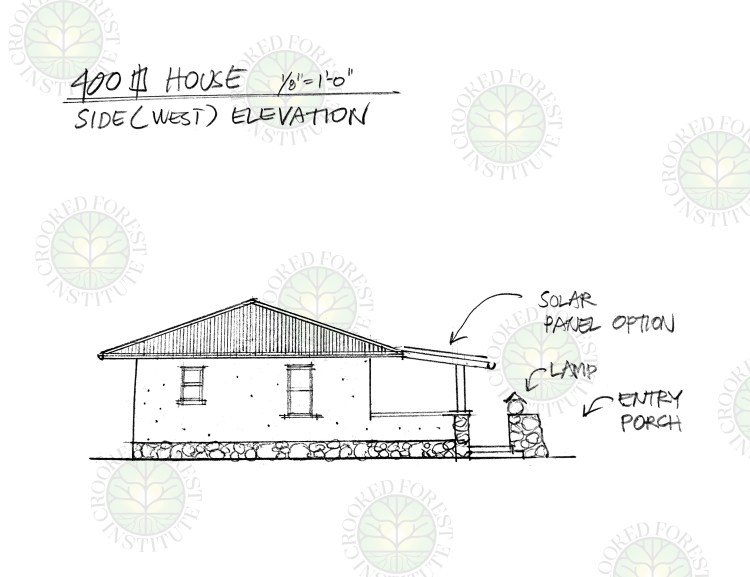
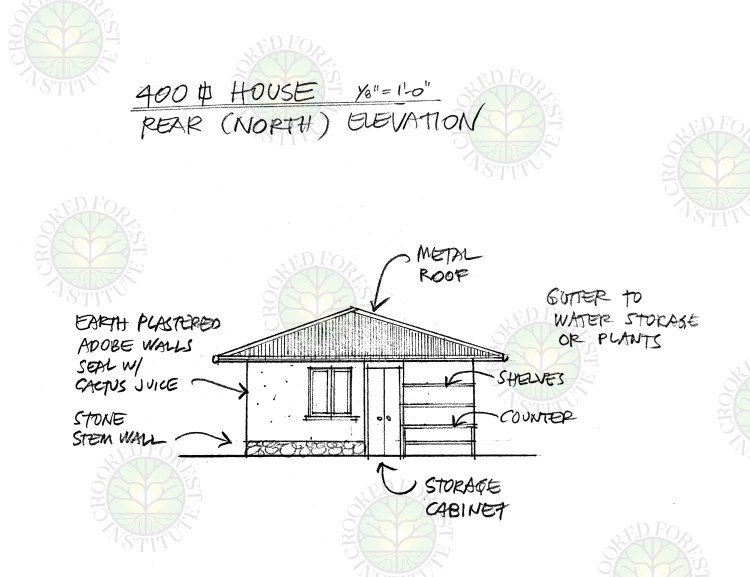
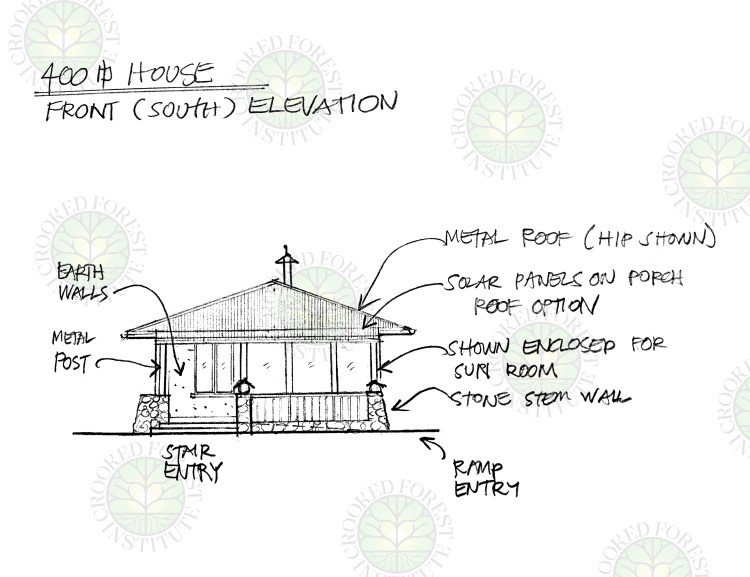
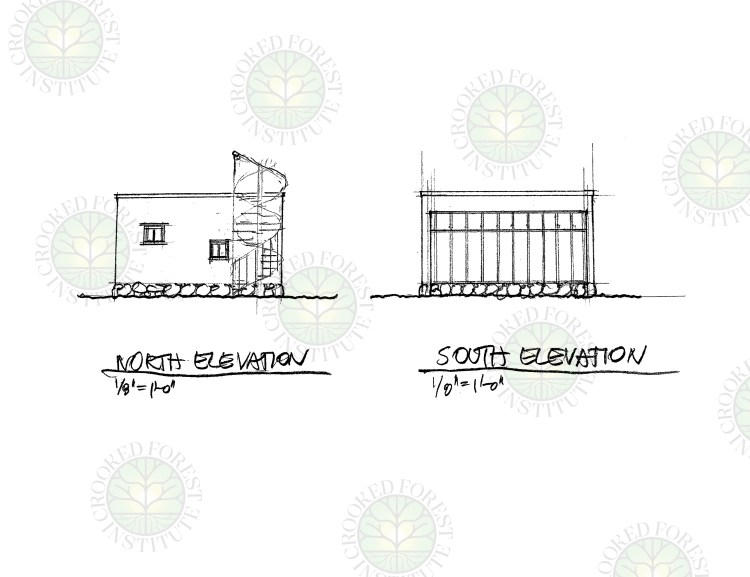
Our 400 square foot home

We’d like to build ten of these on a single commercial septic system.


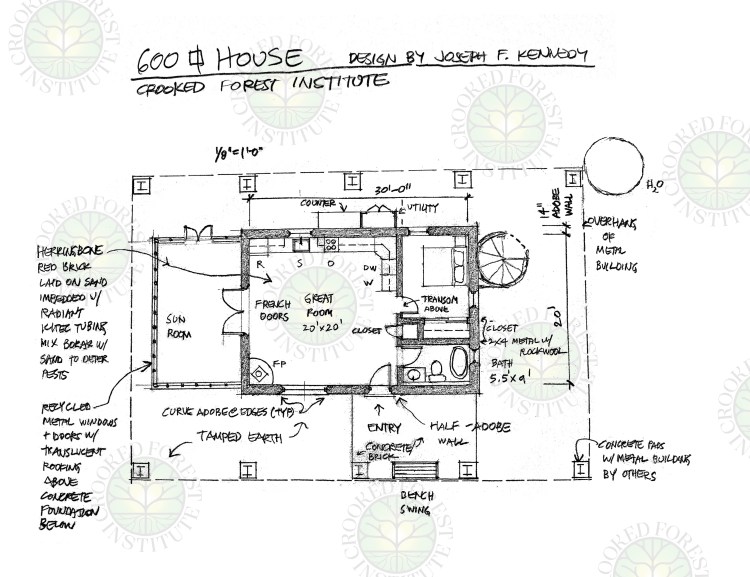
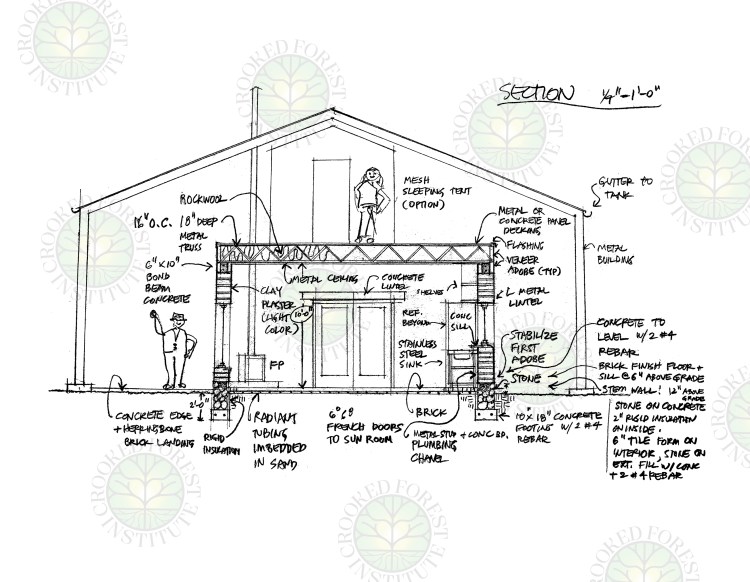
Our 600 square foot home

A larger version, also designed for renewable district utilities.


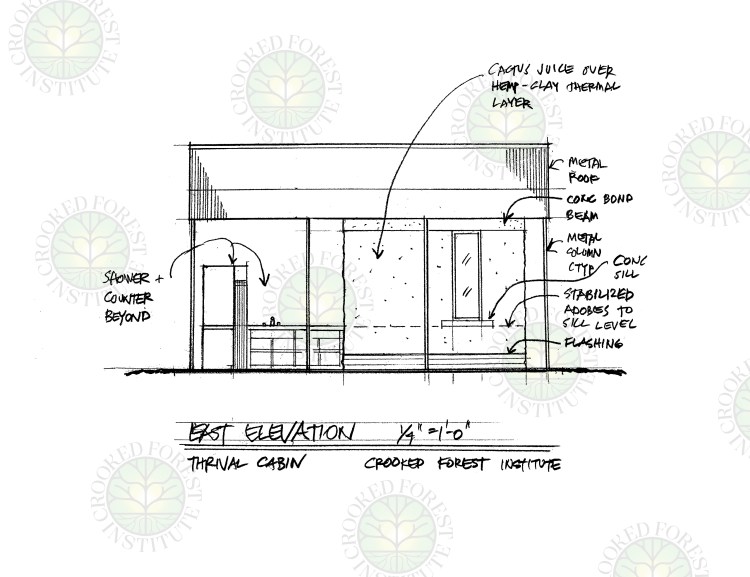
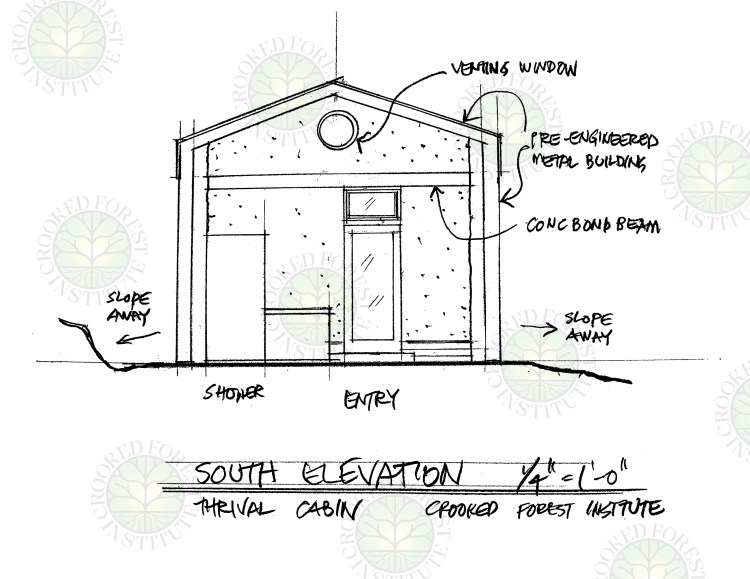
Our 150 square foot “Thrival Cabin”

Our workforce housing cabin, with a 12 foot ceiling and a loft. Ten units will share a common bathroom building.


(A huge shout out to Joseph Kennedy and to Bryan Hyde for finalizing these designs!)

The pricepoint of each of these homes depends on many factors that we don’t yet know, but we finished one prototype (the 150 sq. ftr.) in June 2025 and are working on the second one now (the 600 sq. ftr.) to gather the data. We will keep you posted!

We would like to build whole prototype neighborhoods of each design on our 52 acres.

What do you think?

We need your help to make this vision into a reality for Grant County!

Here are three ways you can join us:
1) Download our app! This is where the conversation is getting into details.
2) Join an Action Team! There are four to choose from. The commitment is one meeting a month for 6 months. We need your skills!
3) Donate. We need all the help we can get. And thank you.

🙏

Download our App! Be part of the Solution

🎉

Hey there! you may prefer to get into mud up to your elbows rather than have a new way to be on your screen. We get that. But if you’d like to be involved in a community conversation about sustainable community development right here right now, we have created a space for you.

The fact is, we have to start these large projects by talking about them.

We need to engage with you and with your neighbors in a meaningful way.

Yes, we will have workshops where you can get muddy! But we need help to organize those. And we’re really excited to have a dedicated space to bat around these ideas.

This is a way for us to share all the resources we are reading, watching and learning from. There are amazing role models that inspire us to be optimistic and inspiration is so much better than doomscrolling!

What we think becomes our reality. We are dreaming this new system into reality. We have a 10 year plan.

We have land. What do YOU think we should do with it? We want your ideas. Join the conversation.

Our Action Teams have chat rooms already set up inside the app. Join a room or the general conversation.

We have put a ton of effort into creating systems that can scale. Now, we are ready to go.

So if you are in, so are we.

For Apple, Download our app here.

For Android, Download our app here.

See you on the inside!

The Crooked Forest Team

The Prospera Partners Process for Crooked Forest

Join Joe and Holly for a conversation about the organizational audit and optimization process that we went through with our nonprofit consultants, Prospera Partners. We reviewed all of our foundational paperwork before delving into a values conversation, drafting a memorandum of understanding and then designing how we would like our board process and community engagement to turn into real action. If you’re curious about the details of how we plan to create sustainable, healthy AND affordable housing in Grant county and beyond, this podcast is for you.

(Even though this podcast is almost 2 hours long, we saved a large segment of audio for later, for when we publish our business plan. So subscribe and come on back later if you’d like the details on that.)

New Video– Prototype Cabin

Thank you to Escher Bowers of Freeman Films for putting together this video on the construction of our Thrival Cabin Prototype! This short film is 11 minutes long and features the audio of when Joe Kennedy and Holly Noonan were interviewed on KURU 89.1 FM community radio.

While we are SO proud to show you what we have been up to, it’s important to point out that this cabin was built for a young woman with extreme environmental sensitivities and therefore we can’t show it to you in person. But not to worry, we will build more!

Thank you for your patience over the last six months while our board focused inwardly to do a thorough audit of our policies, processes and goals. We are almost ready to reveal the fruits of our process with Prospera Partners in an upcoming podcast!

Also, our executive director Holly began her six-month fellowship with the Lincoln Vibrant Communities program in April 2025, and has been delving into this education on Strategic Communication, Leadership and Housing Policy. More about this soon!

Be sure to like and share this video and let us know what you think!

Hurray for Give Grandly 2025!

The following is the text on our Give Grandly Fundraising Page.

In 2024, we purchased 52 acres in the Mimbres Valley without a bank loan. This will become our Education Campus over the next ten years. We will practice by building our designs on this land, and then move to building for the Grant County community, once a Community Land Trust (CLT) land has been established. CLT housing remains affordable generation after generation, it turns renters into owners and creates a much need safety net for our county’s low-income, elderly and disabled populations.

Our solution to the current housing crisis is to become a Non-Profit Housing Developer, with a Vocational Education component.  We will build whole neighborhoods of 400 square foot adobe homes in groups of ten, on shared “RV park” infrastructure. We will use the construction of these ten-house neighborhoods as our classroom, inviting owners, VocEd students and community volunteers to contribute their labor as we complete one home each month. 

We have visited our organizational role models, like Community Rebuilds in Moab, Utah and The School of Constructive Arts in Alpine, Texas to learn to develop building and education systems for ourselves that are already successfully working for them. We will make the compressed earth blocks and adobe bricks on our land, from local soil, and begin the process of creating a certified “CTE” program– Career and Technical Education Program– on our 52 acres in the Mimbres Valley.

We will then build up our capacity in order to build our neighborhoods on Community Land Trust (CLT) land, so that when Silver City and each of the surrounding communities eventually earmark acreage to go into a 501c3 Community Land Trust (CLT) entity, we will be ready. CLTs are a proven method of keeping housing affordable in perpetuity and there are currently 308 CLTs operating successfully in the Unites States.

Eventually, we will run two building teams at once; a skilled team of five builders that goes fast with finely tuned procedures, and a training team that runs alongside them on a separate building, learning as they build. As we train skilled builders, we will hire them and expand. We build the same three designs over and over, with refinements, but very little customization, getting faster and more efficient each time. We will collaborate with The Future Forge, the local non-profit makers-space that hosts a Vocational Education program, to create affordable plug-and-play solutions for kitchens and bathrooms, like steel sinks set into steel tables and kitchen islands. In this way, we create functional, beautiful, simple, affordable homes that offer dignity, safety and community.

Our project originates in the acute lack of housing options for people who are chemically sensitive. We have needed these homes ourselves. But our plan is to build homes for all demographics that have experienced economic disenfranchisement, and earmark 25% of them for people who cannot stay healthy in conventionally-built housing. 

We need to build small homes out of local, healthy soil, because that simply makes the healthiest possible house. It’s probiotic housing! And since our rafters, windows and doors are all metal, these homes are also fireproof. Adobe homes are the historic building style in this region because they work so well to keep cool in the summertime (with no AC) and absorb the sun’s heat in the wintertime, lowering utility costs dramatically when compared with manufactured housing. This offers financial freedom for low income residents.

It has been understood in the community of chemically-sensitive people for 40 years that adobe homes are the top choice for recovering from environmental hypersensitivity. However, most chemically sensitive people, who are already burdened with enormous costs from health issues, can’t afford to live in an adobe home. Adobes used to be for working people, and now they are almost only for wealthy people.  By centering the needs of the chemically-sensitive population within a regenerative economic model, we can create affordable homes that make everyone healthier.

We have been in the process of proposing an intelligent land use regulation update for work-force housing solutions for Grant County that are in line with other New Mexico counties (like Eddy County) which allow for small, permanent structures to be built at RV parks. (Our 400 sq ft homes are the size of the largest RVs, and can use the RV-Park district utility system, but without the need for RV chemicals.) We intend to create shared-infrastructure-neighborhood prototypes on our 52 acre Education Campus. 

Housing can be affordable when homeowners share expenses;

  1. Homeowners can share district water and septic systems,
  2. Homeowners can share a district electical system,
  3. Homeowners can do long-term (99 year) lot leases instead of buying land.

Manufactured Housing Communities and RV Parks provide affordable housing options for New Mexicans– because they share infrastructure expenses– and they must be protected! 26% of housing units in Grant County are “Mobile Homes.” But we can learn from what is working in them and create a long-term solution for affordable housing that is fireproof, locally sourced and made from healthier, more durable building materials.

Crooked Forest Institute is now a member of the Grounded Solutions Network, an agency that helps communities establish Community Land Trusts in order to promote housing solutions that will stay affordable for generations, and to combat systemic inequities.

By teaching adobe building and incorporating regenerative farming methods on our campus, our educational program provides a well-rounded education in localized economic models of sustainable living. There will be an incubator module to encourage students to start their own business for a specialty building trade that is needed by the community, such as plastering, roofing, electrical/solar, agroforestry or plumbing and water catchment. As those businesses develop, we will use our graduates as subcontractors– or hire them– in the process of building new housing on the county CLT.

Whether our graduates get hired by us to build locally or start their own trades business, their experience will position them well as we scale up our model to other communities in New Mexico. Now is the time for innovation that will put home construction back into the hands of communities. 27% of our residential building supplies currently come from China, but they don’t need to. Healthier building materials are right here already, and when we build with earth, we keep our dollars circulating in our own local economy. So let’s build together!


Unfortunately, we won’t be at the Give Grandly Event this year in person! We are so sorry to miss this event, as each year it has been a wonderful opportunity to connect with our community.

But this year, Holly will be in Chicago starting her Lincoln Vibrant Communities Fellowship, while Joe is still in South Africa, developing a sister project in the Regenerative Communities Network.

We look forward to showing you the progress we’ve been making on completing Jade’s Cabin– She’s moving in in May! So Stay tuned…

If you would like to donate, our Give Grandly donation page is live and we thank you deeply for your support!

If you would like to do a recurring monthly donation instead, you can set that up here.

2025 Lincoln Institute Fellowship Cohort

Our Executive Director, Holly Noonan, just got selected to the Lincoln Institute For Land Policy’s Lincoln Vibrant Communities 2025 Fellowship Cohort 🎉

In this Fellowship, she will learn to:

>>>Address critical and complex challenges facing counties and cities, such as housing, climate readiness, land use and water management, transportation, municipal finance, and social equity   

>>>Learn methods to drive change, such as scenario planning, data visualization, building cases and models, storytelling to inspire, and conflict management and mediation   

>>>Acquire actionable leadership skills in the form of situational awareness, dialogue and collaboration, change management, resiliency, and deep cultural competency.”

To learn more, watch this video. https://youtu.be/hUTxR63GIs8?si=1cYlCQh-ORZrxmL8

February Mimbres Messenger Column

Greetings Mimbres Valley!

The Board of Directors at Crooked Forest Institute would like to invite you to come for a walk with us on the 52 acres that the nonprofit purchased in October of 2024. Join us for a walk around the property on Saturday, March 22nd at 10am. It is located on the west side of Hwy 35. (on the left going north) and the entrance is an orange gate approximately across the road from the Frost Brothers billboard. (Just south of the transfer station.)

Looking at the current challenges that are facing our community, everyone can see that we need more housing, better health and more economic stability.

Crooked Forest Institute has been envisioning win-win solutions that contribute to all of these.

In a nutshell, we are working on creating a local-economy hub that will include:

→ A co-operative adobe brickyard– to make a locally sourced, healthy building commodity. Members can get bricks for cost.


→ A Vocational Education program where teens 15-19 can learn to make adobe bricks, and to build and repair fireproof adobe homes.


→ A drylands food innovation hub, where we experiment with how to grow the most amount of food with the least amount of water.


→ A native species propagation nursery for bioregional ecological restoration.


→ Some short term rentals so that people can experience our small home designs first hand.


→ A small subdivision of 12 homes on 8 acres (on our 52) in our Community Land Trust pilot program.


→ An education building that can double as an event center.

We want to support our local economy to provide more of our housing and food. When local independent businesses receive $100 from you, they put most of it back into the local economy and it multiplies. When you spend $100 at chain restaurants or big box stores, it mostly leaves town for good.

As a nonprofit housing developer, we are working to provide housing solutions for those who need it most– low-income, elderly and disabled local residents. Creating a Community Land Trust is a proven strategy for protecting land in perpetuity for the benefit of the community. It creates a safety net for the most vulnerable among us and it is designed by you, to become what you want.

Please Note: We are planning on eventually building homes on a Community Land Trust in or near Silver City that does not actually exist yet.

We are not planning on building housing in the Mimbres Valley. (If the Mimbres Valley eventually creates its own Community Land Trust, we would reconsider this.)

The 52 acres that our nonprofit purchased is to be used as an Education Campus, not as a housing development. There will be some housing on it, so we can practice building our designs, but it will not be high density. We would like this Education Campus to become a community resource for the whole valley.

Ultimately, we aim to prove that it is possible to design and build human settlements that improve the surrounding ecosystem, not injure it.

We are focused on innovating a new system of building, but it’s actually just recreating the traditional, historical way of building. It’s common sense to make bricks out of local soil and teach our kids to build safe, healthy, fireproof homes. We want them to start trades businesses to keep our dollars local!

We want to hear from you! Are you concerned about our plans? Are you excited? Join us on March 22nd! Please write to us at crookedforestinstitute@gmail.com. Sign up for our mailing list at https://crookedforestinstitute.org/.

Ecorestoration and Indigenous Agroecology Traditions

https://www.podbean.com/media/share/pb-t2bpe-17ebdbd

Join us for this deep-dive interview with Coakee William Wildcat, an Ecorestoration and Syntropic Agroforestry educator who originally hails from the Oklahoma Seminole Nation. He celebrates having two lenses to navigate the modern world; He integrates the western science studies of soil biology, botany, ecology, Miyawaki reforestation and ecology/climate physics–including the Biotic Pump Theory– with a deep historical and personal understanding of indigenous agroecology traditions, and weaves them into a coherent picture of what human relationship with Earth looks like when we act as a steward species. When studies show that biodiversity is highest on indigenous-managed land around the world, how do we empower indigenous knowledge-holders during this global climate crisis?

https://www.scientificamerican.com/article/indigenous-lands-ace-biodiversity-measurements/


https://www.sciencedirect.com/science/article/abs/pii/S1462901119301042


https://www.wri.org/insights/indigenous-and-local-community-land-rights-protect-biodiversity


All set! Hope to see you at the Silent Auction Dance Party tonight!

The potluck, DJ and silent auction starts at 5pm. Bidding stops at 7:30. Join us at 1915 N Swan Street, in Silver City.

Check out these amazing donations!!

Thank you SO much for donating to the Benefit for Jade’s Thrival Cabin, but also to our whole cause.

We are on a mission to create healthy AND affordable housing.

Let’s do this! 💪🏼

Crooked Forest Institute

A New Twist on Affordable Housing

Skip to content ↓